
📘 Book Available
To ensure the highest resolution of the report and protect intellectual property rights, the official methodological document has been hosted in our verified repository.
The Architecture of a Suspicion
Every investigation has a visible story and an invisible one. The visible story of this work is contained in its equations, in its tables, in its Monte Carlo simulations, in its statistical goodness-of-fit tests, and in its patrimonial resilience laboratories. The invisible story, on the other hand, began long before a single line of code existed. It began with a suspicion.
For decades I observed the functioning of financial markets, the evolution of indexed instruments, and the increasingly distant relationship between theoretical explanations and the concrete experience of those who interact with them. The Unidad de Fomento had historically been presented as a neutral mechanism for preserving real value. However, there was a question that never seemed to be explicitly formulated: What happens if indexation is not perfectly neutral?
That question, seemingly simple, ended up transforming into the central axis of this entire investigation. What initially appeared to be a minor difference between rates ended up revealing a much deeper structure.
The first contribution of this work consisted precisely in abandoning the isolated observation of prices and concentrating on the observation of relationships. The aim was not to explain a rate. The aim was to explain a gap. And it was at that moment that the conceptual architecture supporting the entire investigation appeared.
The triangulation between the international efficient rate, the indexed rate, and the marginal market rate made it possible to identify a phenomenon that until now lacked an explicit formulation within traditional financial analysis. The existence of a region where arbitrage ceases to operate fully. A region where competitive equilibrium fails to fully close the observed differentials. A region where the system remains trapped.
The naming of this phenomenon as the Financial Entrapment Zone constitutes one of the central conceptual contributions of this investigation. It is not a metaphor. It is a verifiable structural condition. An economic geometry where agents remain confined between an efficient rate they cannot reach and a market rate they cannot avoid.
From that observation a second question arose. If entrapment exists, what is its Cost?
The answer led to the formulation of the concept of Insularity Cost. The investigation reveals that a small, open, and highly indexed economy can generate persistent differentials that survive even after controlling for credit risk, liquidity, sovereign premiums, and conventional market factors. The Insularity Cost represents precisely that residual friction. It is not a risk spread. It is not a liquidity premium. It is not a measurement error. It is the observable manifestation of a structural disconnection between the local financial equilibrium and the international financial equilibrium. However, identifying a gap was not enough. It was necessary to quantify its consequences.
And it was precisely there that the concept that ended up articulating the entire investigation appeared: the Asymmetric Indexation Surplus (AIS). The AIS made it possible to transform an economic intuition into a measurable magnitude. For the first time it was possible to separate the effectively observed market rate from the rate that theoretically would have prevailed under conditions of efficient convergence. The difference between the two ceased to be a perception and became a quantifiable object.
The investigation then advanced from description toward causality. The question ceased to be how much surplus exists. The question became what effects it produces.
The answer led to a methodological decision that ended up defining the innovative character of the study. Instead of assuming normal distributions or linear approximations, the choice was made to directly investigate the statistical nature of the phenomenon.
The results were revealing. The goodness-of-fit tests showed that the observed dynamics did not respond to the typical behavior of Gaussian systems. Patrimonial deterioration exhibited memory, exhibited persistence, exhibited dependence. It exhibited tails. In other words, it exhibited fatigue.
It was then that the Weibull distribution emerged as the natural mathematical language of patrimonial erosion. The importance of this finding can hardly be overstated. Because the incorporation of Weibull did not constitute a simple statistical improvement. It constituted a complete conceptual reinterpretation of the phenomenon.
The system ceased to be seen as a sequence of independent shocks and began to be understood as an accumulative process of financial wear. The temporal persistence identified through AR(1) processes, the structural dependence captured through copulas, and the presence of extreme events reflected in the distribution tails converged toward a single conclusion: patrimonial erosion was not an accident. It was an emergent consequence of the system's structure.
Subsequently, the introduction of the Gamma Structural Adjustment added an additional dimension of analytical depth. Far from invalidating the results obtained through Weibull, Gamma made it possible to understand something even more important. That the statistical intensity of the fit and the economic functionality of the phenomenon do not necessarily coincide. Gamma fitted marginally better. Weibull explained better. Gamma described. Weibull interpreted. Gamma quantified the friction. Weibull revealed the fatigue.
This difference ended up becoming one of the most relevant methodological conclusions of the study. Because it demonstrated that the best statistical fit is not always the best economic model.
The investigation then advanced toward its final stage. The construction of the Pazos Integral made it possible to transform all the previously developed components into an integrated measure of patrimonial resilience. For the first time it was possible to quantify the economic drift induced by the indexation system on the debtor's patrimony. Not as an instantaneous loss. Not as an accounting difference. But as a dynamic trajectory of accumulative erosion.
The stochastic laboratories showed that such erosion not only existed, but also exhibited highly asymmetric characteristics. A relatively small proportion of extreme scenarios concentrated a disproportionately high fraction of the total economic damage. This observation ended up connecting naturally with expectations theory. If agents internalize the possibility of losses concentrated in the tails, then the phenomenon ceases to be exclusively microeconomic. It begins to acquire systemic relevance. It is precisely here that the investigation makes perhaps its most ambitious conceptual leap.
The introduction of expectations endogeneity made it possible to connect an apparently local contractual friction with potential mechanisms of macrofinancial propagation. It was not asserted that the UF determines the exchange rate. It was not asserted that the AIS alone explains exchange rate fluctuations. The thesis defended was much more prudent and, precisely for that reason, much more robust. It was shown that a sufficiently persistent friction can rationally modify agents' expectations. And that, under certain conditions, those expectations can transform into an additional channel of economic transmission.
The relevance of this conclusion transcends the Chilean mortgage market by a wide margin. Because it suggests that certain contractual imperfections may possess cumulative effects capable of propagating beyond the markets where they originate.
Finally, after all the models, all the laboratories, all the validations, and all the simulations, the fundamental conclusion remains surprisingly simple. The perfect neutrality of indexation could not be corroborated. On the contrary. The evidence obtained points consistently toward the existence of a persistent patrimonial transfer associated with a long-term structural friction.
That structural transfer was structured under the following analytical ecosystem:
- ✅ Conceptualized through the AIS.
- ✅ Measured through triangulation.
- ✅ Explained through Weibull.
- ✅ Fitted through Gamma.
- ✅ Quantified through the Pazos Integral.
- ✅ Validated through stochastic simulation.
That is the true architecture of this investigation. Not a collection of techniques. Not a succession of chapters. Not an accumulation of results. But a logical and continuous chain where each component exists because the previous one demands it. From an initial suspicion to quantifiable evidence. From a professional intuition to a formal structure. From an uncomfortable question to a theory susceptible to being debated, refuted, expanded, or refined by future research. And precisely there lies its greatest strength. Because truly important investigations are not those that close a discussion. They are those that inaugurate it.
However, the invisible story —the one that is rarely told— is the one that truly determines the impact of an investigation. That story speaks of the questions that were not asked, of the data that were not included, of the assumptions that were taken for granted. This study seeks precisely that: to make the invisible visible, to question the established, and to offer a critical view on one of the pillars of the Chilean financial system.
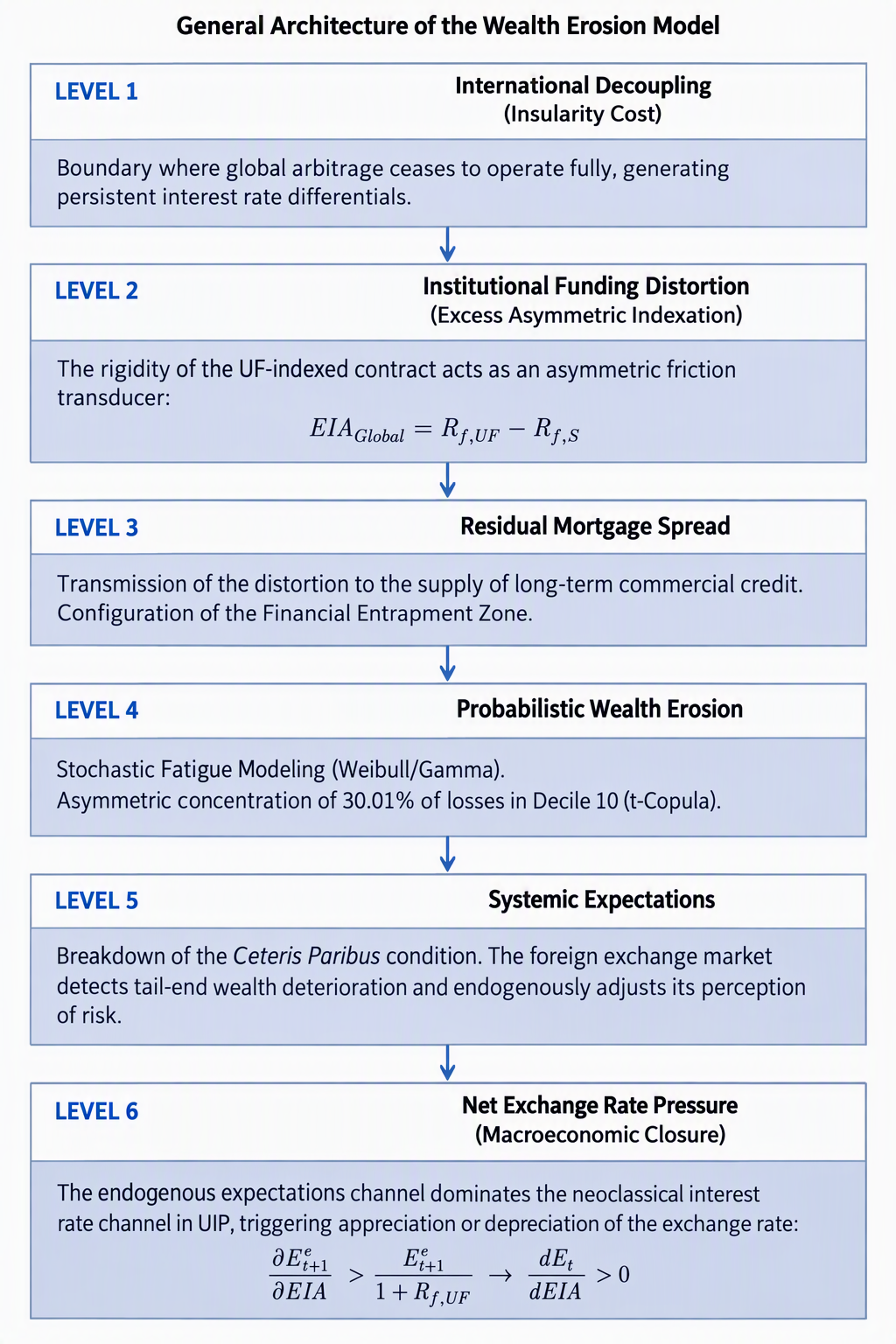
Architecture of Patrimonial Erosion
Novagestión Financial Consulting SpA
Commitment to excellence, rigorous analysis, passion for service.
The document is not yet translated. We will be publishing it soon.